Spinal Decompression vs. Chiropractic Care for Sciatica
Sciatica treatment may involve spinal decompression therapy, chiropractic adjustment, or both. Arrowhead Clinic Chiropractor Garden City evaluates symptoms, movement, and suspected nerve involvement before recommending an approach. The decision depends on the source of irritation, symptom behavior, treatment tolerance, and response to clinical evaluation.
Request an EstimateOptions at a Glance
Spinal decompression and chiropractic care use different methods to address sciatica. We match the option to the findings from your symptom review and movement assessment.
- Spinal decompression therapy may fit symptoms linked to disc irritation, nerve compression, or sensitivity to spinal loading.
- Chiropractic adjustment may fit joint restriction, reduced spinal mobility, muscle tension, or altered movement patterns.
Spinal Decompression vs. Chiropractic Care at a Glance
Spinal decompression uses controlled traction-based unloading, while chiropractic adjustment uses targeted manual or instrument-assisted movement to address joint and movement restrictions. Neither option is automatically better for every pattern of low back pain or radiating leg pain.
| Factor | Spinal Decompression Therapy | Chiropractic Adjustment | Key Trade-Off |
|---|---|---|---|
| Primary method | Controlled traction-based unloading | Manual or instrument-assisted movement | The approach targets different mechanical factors |
| Treatment cost | Depends on the equipment-based therapy, evaluation needs, and care plan | Depends on the adjustment method, evaluation needs, and care plan | A direct quote requires a clinical evaluation |
| Treatment timeline | Varies with symptom behavior and treatment response | Varies with movement findings and treatment response | Progress is reviewed as symptoms change |
| Maintenance care | May be considered when symptoms return or loading remains sensitive | May be considered when joint restriction or movement limits recur | The need depends on ongoing findings |
| Best for | Some disc-related symptoms and patients who tolerate unloading | Some joint, mobility, and movement-related symptoms | Suitability depends on the clinical picture |
How Spinal Decompression Addresses Sciatica
Spinal decompression therapy is a non-surgical therapy that applies controlled unloading to the spine to help manage symptoms associated with irritated spinal structures.
Controlled traction is applied through the lumbar spine with the goal of reducing stress during the session. The approach may be considered when a spinal disc, nerve root, or nearby tissue appears linked to nerve irritation and leg pain.
We review how low back pain and radiating leg pain respond to position and movement before deciding whether decompression fits the suspected source.
Advantages of Spinal Decompression for Sciatica
Spinal decompression may be useful when symptoms appear sensitive to compression or loading. Treatment tolerance remains important, so we monitor how symptoms respond during and after care.
Best for: Spinal decompression may fit patients whose symptom pattern suggests disc irritation or sensitivity to spinal loading.
How Chiropractic Adjustments Address Sciatica
Chiropractic adjustment is a hands-on or instrument-assisted technique that applies a controlled force to a joint to support spinal mobility and movement.
An adjustment may address restricted spinal joints, altered movement, or muscle tension around the lumbar spine. Improving movement in related joints can reduce mechanical stress that may affect the sciatic nerve.
We choose manual adjustment, instrument-assisted adjustment, or another approach based on the spinal examination and how your symptoms behave with movement.
Our Sciatica Treatment approach focuses on matching care to the findings rather than using the same technique for every patient.
Advantages of Chiropractic Care for Sciatica
Chiropractic care may help when joint mobility, movement patterns, or muscle tension contribute to functional limitations. We use the evaluation to identify which findings may be addressed safely.
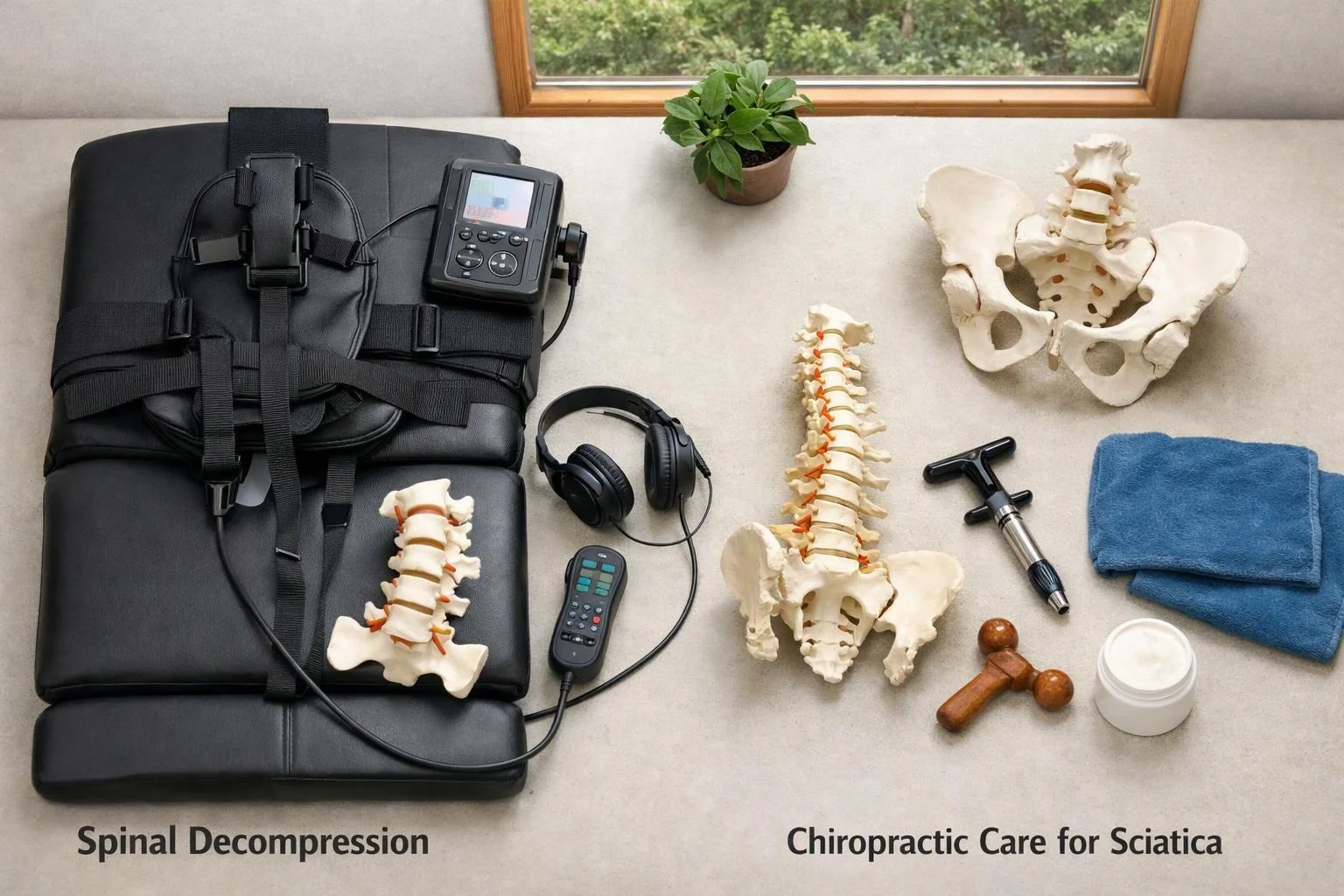
Best for: Chiropractic care may fit patients whose symptoms are linked to joint restriction, reduced mobility, or altered movement patterns.
Which Sciatica Treatment Fits Your Symptoms?
The better option depends on the suspected source of nerve irritation, symptom behavior, movement findings, and how the patient responds to an evaluation.
Sciatica symptoms can include low back pain, leg pain, numbness, tingling, or weakness. The location and behavior of these symptoms help us assess whether the pattern is more consistent with disc irritation, joint restriction, muscle tension, or another concern.
Our clinical evaluation includes a review of your symptom pattern and a movement assessment. We use those findings to build a treatment plan and adjust care when the treatment response does not match the expected pattern.
What Changes the Cost of Sciatica Treatment?
The cost of sciatica treatment depends on the selected therapy, evaluation needs, treatment frequency, and overall care plan; we explain the recommended care and quote details directly.
Spinal decompression therapy and chiropractic adjustment can involve different equipment, techniques, and care requirements. The suspected cause of symptoms can also affect which services are included in the plan.
We review the initial evaluation, recommended treatment, expected care frequency, and any maintenance care before providing quote details. You can request a quote through our contact page.
What to Expect During an Evaluation
A sciatica evaluation begins with your medical history and symptom pattern, then moves through physical findings that guide the treatment recommendation.
When Sciatica Symptoms Need Medical Assessment
Severe or rapidly worsening symptoms, progressive weakness, saddle numbness, or bowel and bladder changes require prompt medical assessment before routine chiropractic treatment.
Progressive weakness can signal a more serious nerve problem. Loss of bowel control, loss of bladder control, or numbness in the saddle area are red flag symptoms that need urgent attention.
We pause routine treatment recommendations when these warning signs appear and advise prompt medical evaluation. Sudden or severe changes should not be managed through routine self-care alone.
Questions About Sciatica Treatment Choices
Can chiropractic adjustments help sciatica caused by a disc problem?
Yes, chiropractic adjustments may help some people with disc-related sciatica when the clinical evaluation supports movement-based care. Arrowhead Clinic Chiropractor Garden City reviews symptom behavior, neurological symptoms, and spinal findings before recommending an adjustment.
Is spinal decompression safe for every person with sciatica?
No, spinal decompression is not appropriate for every person with sciatica. Suitability depends on the symptom pattern, medical history, neurological findings, and treatment tolerance identified during the evaluation.
Can spinal decompression and chiropractic adjustments be used in the same care plan?
Yes, spinal decompression and chiropractic adjustments may be used in the same care plan when the evaluation supports combining them. We select and sequence care based on the suspected source of irritation and the patient’s treatment response.
What symptoms suggest that sciatica needs medical attention before chiropractic care?
Progressive weakness, saddle numbness, loss of bowel control, loss of bladder control, or severe and worsening symptoms suggest that sciatica needs prompt medical assessment before routine chiropractic care.
Choose the Next Step for Sciatica Care
Arrowhead Clinic Chiropractor Garden City helps match sciatica symptoms with an appropriate next step through a focused clinical evaluation. Contact our team to discuss your symptoms, evaluation needs, and treatment plan.