
What Is Joint Mobility?
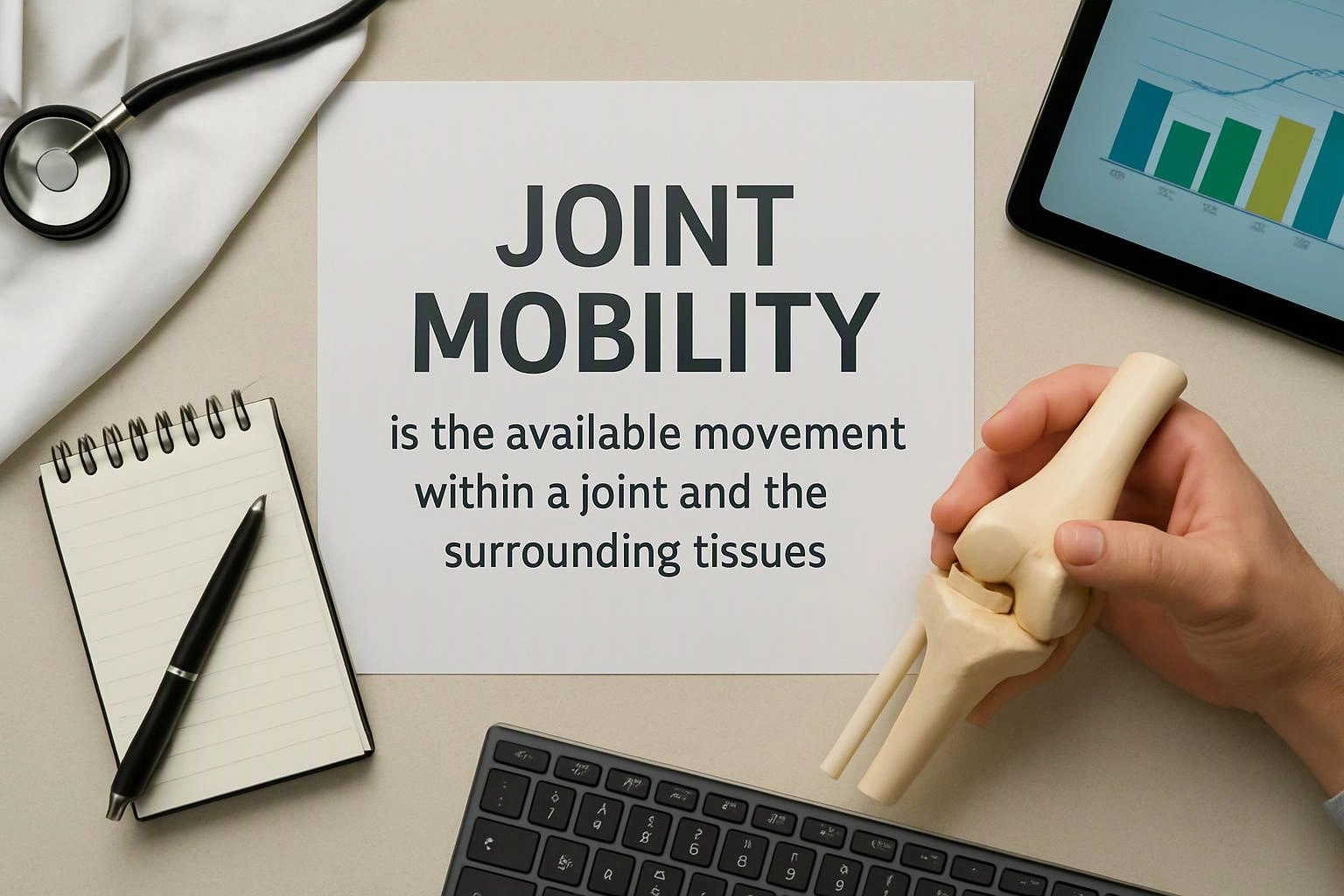
Joint Mobility is the available movement within a joint and the surrounding tissues that support that movement. It describes how freely a joint moves through its usable range, including the direction, control, and ease of motion. Physical therapists assess joint mobility to understand movement limits and guide appropriate exercise or manual techniques.
Quick Facts About Joint Mobility
Category
Movement assessment concept
Used for
Physical therapy planning
Common confusion
Mobility is not identical to flexibility
Also called
Joint Range of Motion
Often discussed with
Physical Therapy
Key Takeaways About Joint Mobility
- Mobility includes movement quality, control, and available range.
- Physical therapy may assess mobility during movement and specific tasks.
- Joint mobility is not the same as muscle strength or flexibility.
How Joint Mobility Works

Joint mobility reflects the movement available at a joint and the way nearby tissues guide that movement. A physical therapist may observe active motion, assisted motion, and movement during a practical task. The assessment considers control and comfort, not only how far the joint travels.
Related glossary terms: Range of Motion, Facet Joint, Cervical Spine.
Movement depends on several connected structures. The joint surfaces guide motion, while muscles, tendons, ligaments, and the joint capsule help control it. Physical therapy may address mobility through guided movement, stretching, strengthening, or manual techniques selected for the person’s findings. Range of motion describes the distance a joint moves, while mobility also considers how that movement feels and functions.
From the Arrowhead Clinic Chiropractor Garden City team
When we assess joint mobility, we observe how a person moves and compare that motion with the task they need to perform. Our team considers movement control, comfort, and nearby muscle function before selecting physical therapy activities. We adjust the approach as the person’s movement pattern changes.
Joint Mobility in Practice: A Real-World Example
A person recovering from an ankle injury may have limited joint mobility when stepping down from a curb. Physical therapy may assess the ankle during that task and use guided movements or strengthening exercises to support smoother motion.
Related Services
Related Terms
Range of Motion
Range of Motion is the available movement at a joint or body region, described by the…
Facet Joint
A Facet Joint is a small synovial joint at the back of the spine that connects…
Cervical Spine
Cervical Spine is the upper section of the spinal column that supports the head and connects…
Lumbar Spine
Lumbar Spine is the lower section of the spinal column between the thoracic spine and the…
Arrowhead Clinic Chiropractor Garden City
Have Questions About Joint Mobility?
Contact Arrowhead Clinic Chiropractor Garden City for practical guidance on Joint Mobility and related chiropractor work in Garden City.